
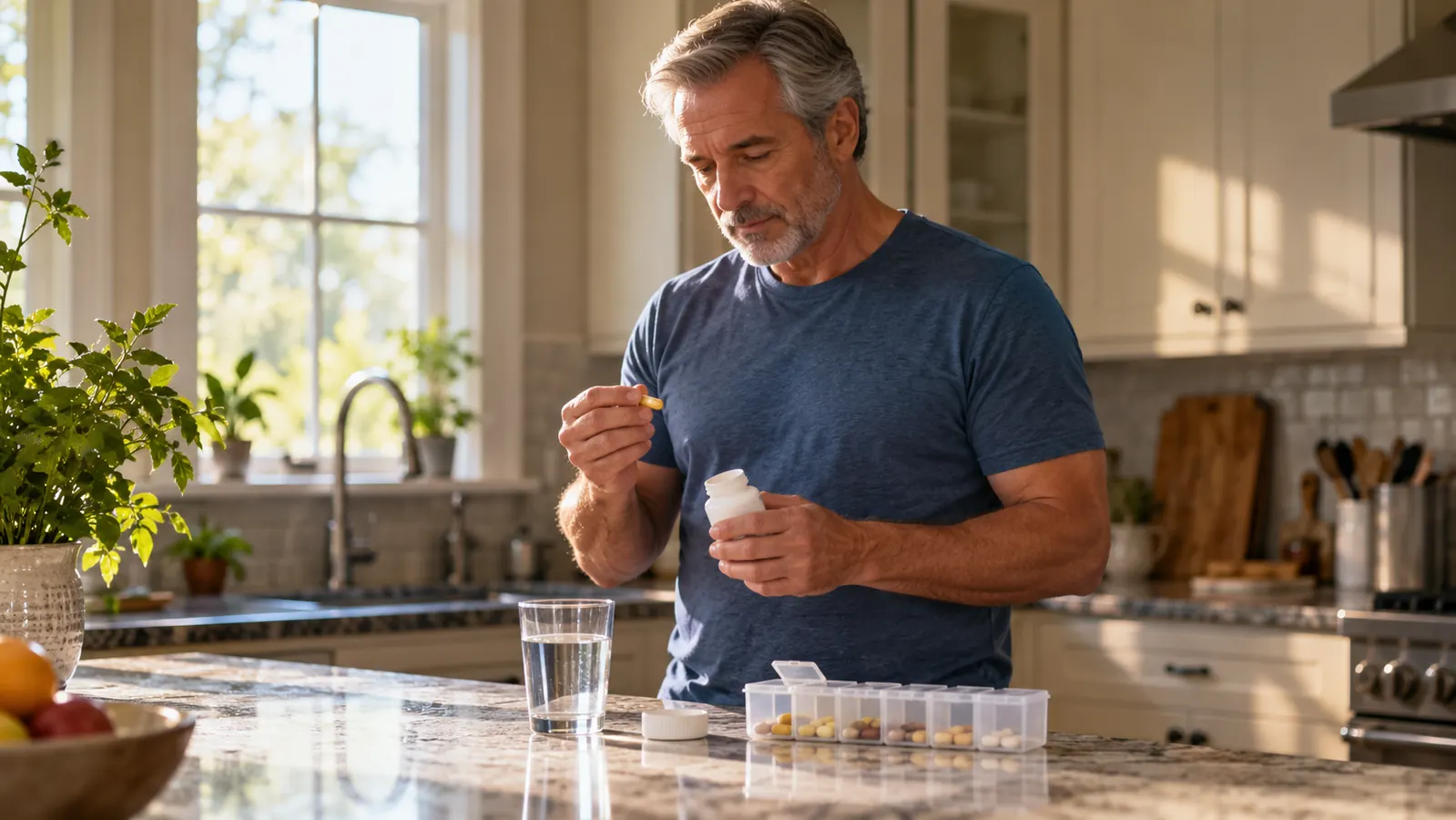
If you've been reading about tongkat ali for more than ten minutes, you've probably seen the blends: tongkat plus fadogia, tongkat plus ashwagandha, tongkat plus a list of things you can't pronounce. I get the appeal. One bottle, one scoop, done. But after two and a half years of taking Double Wood Supplements Tongkat Ali 1,020mg (200:1), I've learned to read the label before I read the marketing. This is the comparison I wish I'd had before I bought my first bottle.
Here's the short answer: a single-ingredient tongkat lets you control the dose, the timing, and the cycle. A fadogia blend bundles two herbs that are often talked about together, which is convenient, but you give up that control and you take on more unknowns. For a 61-year-old guy who wants to know exactly what he's swallowing, the simple label won. Here's why.
| Double Wood Tongkat Ali | Tongkat + Fadogia Blend | |
|---|---|---|
| What's in the capsule | One ingredient: tongkat ali extract, 200:1, 1,020mg per serving | Two herbs in one capsule, sometimes with a proprietary blend that hides the amount of each |
| Dose control | You set the dose and the schedule; easy to cycle five days on, two days off | Both herbs come fixed together; to change one you change both |
| Human research | Tongkat has decades of studies on mood, energy and vitality | Fadogia has far less human research; most of the interest is early-stage |
| Convenience | One bottle, one serving, one thing to track | One bottle covers two herbs at once |
| Cost | You pay for one ingredient, and the bottle lasts a full cycle | You pay for two herbs even if you only want one |
| Best for | Men who want to know exactly what they're taking | Men who want a two-herb stack in one capsule |
How I Put This to the Test
Before I tell you which one I'd pick, you should know how I got here. I'm Ray, 61, a retired union electrician in Parma, Ohio. Around 57 I noticed I was wiped out by evening, my drive had dropped, and my stamina wasn't what it used to be. My doctor checked me over, and since my blood pressure is managed with one daily medication and I'm not on nitrates, he said a reputable supplement was fine to try alongside more walking and better sleep.
I started with a cheap unbranded tongkat from a marketplace seller. The price was tempting, but the label was a joke. No lab testing, no clear extract ratio, no company you could call. I gave it up after a few days because I didn't trust what was in the capsule. Then I switched to Double Wood Supplements, one of the brands my doctor's nurse mentioned, and I've used it for about two and a half years now.
My routine hasn't been complicated. I take it five days on, two days off, which is how a lot of tongkat users cycle it. I take it with breakfast, I walk about two miles most mornings with my wife Linda, and I cut back to two beers on weekends. I'm not here to tell you the supplement did everything. It didn't. But it earned a place in a routine that also includes better sleep and more movement.

What the Labels Actually Say
The difference between a single-ingredient tongkat and a fadogia blend usually comes down to the back of the bottle. A single-ingredient label like the Double Wood Supplements one lists one thing: Tongkat Ali extract, 1,020mg, 200:1. You know what you're getting, how much, and what ratio. That's rare in this aisle.
A fadogia blend, by contrast, lists two herbs, and sometimes a proprietary blend. Proprietary blend is the phrase that should make you slow down. It means the manufacturer lists the total weight of the blend but not the amount of each herb. You might be getting mostly tongkat with a sprinkle of fadogia, or the reverse. You can't adjust one without the other, and you can't know if the dose of either matches what the research actually used.
That's not to say every blend is bad. Some brands list exact amounts of both herbs, and those are worth a look. But if you're comparing a transparent single-ingredient label to a blend that hides its math, the simple label is the safer bet. This is exactly the kind of thing I wish someone had explained to me before my first purchase.
What I Noticed Over Two and a Half Years
I keep a small notebook in the kitchen drawer. When I started the Double Wood Supplements bottle, I wrote down three things: energy at 3 PM, drive on weekends, and how I felt on the morning walk. I didn't expect overnight changes, and I didn't get them. The first few weeks were unremarkable. Somewhere around week three or four, I noticed I wasn't reaching for that third cup of coffee as often.
By the second month, the pattern was consistent enough to write down. My afternoon energy was steadier, not dramatic, just steadier. I had more gas for the two-mile walk with Linda, and I felt more like my old self on date night. I want to be careful here: I'm not claiming the supplement did all of that. I was also sleeping better and moving more, and my doctor had given me the green light. But the change was real, and it lined up with the weeks I was taking tongkat consistently.
The other thing I noticed was how easy it was to stick with. One bottle, one serving, five days on, two days off. No mixing, no measuring, no second bottle to forget. That sounds small, but at 61, routine is everything. If a supplement is annoying to take, you won't take it, and if you don't take it, it doesn't matter how good the label is.
How to Read a Tongkat Label
If you're standing in the supplement aisle, here's what I'd look for. First, the extract ratio. A 200:1 extract like this one is concentrated, so a 1,020mg capsule is a real serving, not a speck of powder in a sea of rice flour. Second, the amount per serving. If the label says 'proprietary blend' and doesn't list individual amounts, you're guessing. Third, third-party lab testing. A reputable brand will tell you if the product is tested for purity and potency. Double Wood Supplements publishes that kind of information, and that's a big part of why I trusted it.
I'd also look at the company behind the bottle. Can you find a phone number? A physical address? Do they answer questions? The cheap unbranded tongkat I tried first had none of those. It was just a bottle with a name I couldn't pronounce and a label that looked like it was printed in someone's basement. When I switched to a company with a real presence and a real label, the whole experience changed.

Questions to Ask Your Doctor
I'm not a doctor, and I'm not going to pretend to be one. What I can tell you is what my doctor asked me, because it's probably what yours will ask too. Are you on blood pressure medication? Are you on nitrates? Do you have any history of prostate issues? Have you had blood work done recently? Those four questions took about two minutes, and they told him whether tongkat was worth trying.
The answer for me was yes, with one daily blood pressure medication and no nitrates, a reputable supplement was fine to try. He also said something I've never forgotten: no supplement replaces sleep, movement, and decent food. Tongkat is not a prescription drug, and it's not a replacement for one. It's a support. If anyone tells you it will fix your testosterone or your stamina the way a medication would, that's a red flag.
And please, stay away from gas-station pills and imported 'instant' products. The FDA has found hidden drug ingredients in a lot of them, and they're not worth the risk to your heart or your health. If a label doesn't list the ingredients clearly, or if the bottle promises results overnight, put it back on the shelf. The right supplement is the one you can explain to your doctor, not the one you have to hide.
Where Double Wood Tongkat Ali Wins
The biggest reason I stayed with Double Wood Supplements is that label. It says Tongkat Ali 1,020mg, 200:1 extract, 120 capsules. No proprietary blend, no 'energy matrix,' no asterisk. When you're 61 and you've already been burned by an unbranded bottle, that clarity is worth a lot. It also makes it easy to talk to your doctor about what you're taking, because you can tell them exactly what's in it.
The 200:1 ratio matters too. It means the extract is concentrated, so 1,020mg of the powder is a meaningful serving, not a capsule full of filler. I take it five days on, two days off, and I can do that because there's only one ingredient to manage. If I want to change the dose, I change the dose. With a blend, I'd be changing both herbs at once, and I'd have no way to know which one I was actually responding to.
Where Fadogia Blends Win
I'm not here to trash fadogia. The interest in it is real, and the idea of pairing it with tongkat comes from the same body of research that got me interested in tongkat in the first place. If you and your doctor have talked about fadogia specifically, and you want both herbs in one serving, a blend is the convenient way to get them. One bottle, one scoop, no second purchase to forget.
The honest tradeoff is that fadogia has less human research behind it than tongkat. That doesn't mean it's useless, it means the evidence is thinner, and a blend makes it harder to know how much of each herb you're actually getting. If you decide to try one, look for a brand that lists the exact amount of each herb, not a proprietary blend. And if the label is vague, treat that as a red flag, not a detail.
The simple label I've trusted for two and a half years
One ingredient, 200:1 extract, easy to cycle, and easy to explain to your doctor. If you're comparing tongkat options, start here.
Amazon Check Today's Price on Amazon →Who Should Buy Which
Buy the Double Wood Supplements bottle if you want to know exactly what you're taking, if you like being able to adjust the dose and the cycle, and if you'd rather add one thing at a time to your routine. That's been my approach since I started this whole experiment at 57: one supplement, three months, honest notes, then decide. It's slower than buying a blend, but it's a lot easier to figure out what's actually working.
Consider a fadogia blend if you and your doctor have specifically talked about fadogia and you want both herbs in one serving. Just look for a label that lists the amount of each herb, not a proprietary blend. And if a bottle shows up with no lab testing, no dosage information, and a name like 'Rhino Max,' put it back. That's the gas-station stuff the FDA keeps finding hidden drug ingredients in, and it's not worth the risk.
One more thing I'd tell any guy my age: talk to your doctor before you start anything. I did, and it took five minutes. He checked my meds, reminded me that no supplement replaces sleep and movement, and gave me the green light. That conversation is worth more than any label, because the right supplement for the guy next to you in the pharmacy aisle might not be the right one for you.
Still deciding? Start with the one-ingredient bottle.
Talk to your doctor first, especially if you're on blood pressure or heart medication. Then let the label do the talking. Double Wood Supplements Tongkat Ali is the bottle I reach for.
Amazon Check Today's Price on Amazon →